
Speech Issues — Oral Causes, Tongue Tie & Expert Treatment in Bangalore
Speech issues arising from the mouth, like restricted tongue movement, misaligned teeth, missing teeth, or palate structure, are frequently overlooked as dental problems. Families might seek speech therapy for years before anyone checks if the tongue, lips, teeth, or palate are physically capable of producing normal sounds.
At Dental Solutions Clinic in Indiranagar, Bangalore, two specialist clinicians manage oral causes of speech difficulty. Tongue tie and lip tie are treated by Periodontist Dr. Balasubramanya K V, MDS Periodontics, LANAP Certified Practitioner and Fotona LightWalker Certified Operator, using the Fotona LightWalker laser for precise, minimally invasive release. Orthodontic causes — open bite, misalignment, narrow arches — are managed by Prosthodontist and Certified Invisalign Provider Dr. Ramya Balasubramanya, MDS Prosthodontics, using Invisalign, Clear Path aligners, or fixed appliances where indicated.
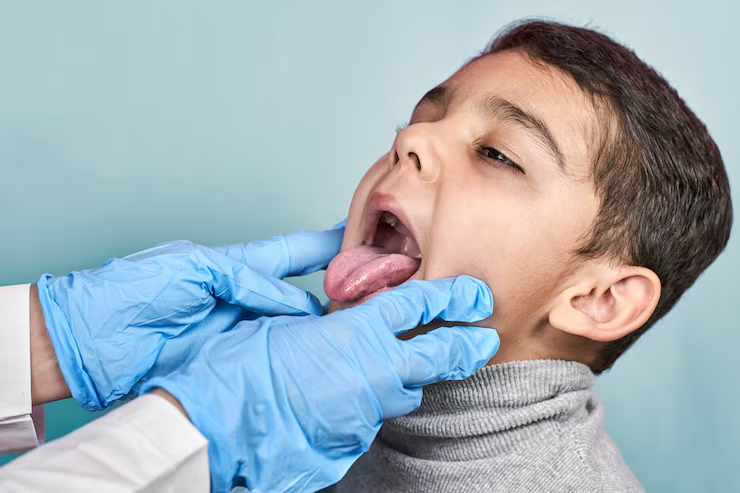
What Are Dental-Related Speech Issues?
Speech is a mechanical process: airflow from the lungs passes through the larynx to produce voice, while the articulators, including the tongue, lips, teeth, and palate, shape this airflow into specific sounds. Each sound in a language relies on particular contact or proximity between these structures. When anatomy is abnormal, such as a tongue restricted by a tight frenum, front teeth that do not meet, a narrow or high palate, or missing teeth that disrupt the oral seal, certain sounds become mechanically more difficult to produce accurately.
Dental-related speech problems are therefore structural rather than neurological. The challenge lies in the mouth’s anatomy, not the brain’s ability to plan or process speech. This distinction matters because treatment differs: when the cause is structural, procedures such as laser frenectomy, orthodontics, palatal expansion, or prosthetic tooth replacement directly address the limitation. Speech therapy alone, without correcting a significant structural problem, may provide only partial or temporary improvement.
Symptoms of Dental-Related Speech Issues
Structural oral issues are most likely to affect sounds that need precise tongue or lip positioning against the teeth and palate. Signs can include:

- A frontal lisp, where /s/ and /z/ sounds are produced with the tongue between or against the front teeth instead of just behind them, often associated with an open bite.
- A lateral lisp, a “wet” /s/ sound caused by air escaping over the sides of the tongue, sometimes linked to tongue posture and a narrow palatal arch.
- Difficulty with /t/, /d/, /n/, /l/ — sounds that require the tongue tip to contact the ridge behind the upper front teeth; restricted in significant tongue tie.
- Difficulty with /r/, which needs tongue body elevation and can be affected in posterior tongue restriction.
- Difficulty with /f/ and /v/, which need the upper front teeth to meet the lower lip; altered by missing upper incisors, deep bite, or large overjet.
- Difficulty with /p/, /b/, /m/, which require a complete lip seal; sometimes affected by a restrictive upper lip tie.
- Hypernasality or nasal air escape for sounds that should be oral, more commonly related to palatal or velopharyngeal structure, but sometimes seen alongside dental issues.
- Compensatory articulation patterns, where a person develops alternative movements to “work around” the structural restriction, which can persist even after anatomy is corrected.
- Reduced overall speech clarity in young children, where multiple structural factors affect intelligibility.
- Breastfeeding or early feeding difficulties in infants, where tongue tie affects latch, milk transfer, and maternal comfort, often preceding later speech concerns.
Causes of Dental-Related Speech Issues
Common structural causes include:

Tongue tie (ankyloglossia):
A short, thick, or forward-attached lingual frenum that limits tongue elevation, protrusion, and side-to-side movement; can affect tongue-to-palate contact for several sounds, though many mild ties do not cause speech problems.

Lip tie
An overattached labial frenum restricting upper lip mobility, potentially affecting bilabial sounds and oral seal and contributing to a gap between upper front teeth.

Anterior open bite
Upper and lower front teeth do not meet, allowing air to leak through the gap during sibilants and often causing a frontal lisp.
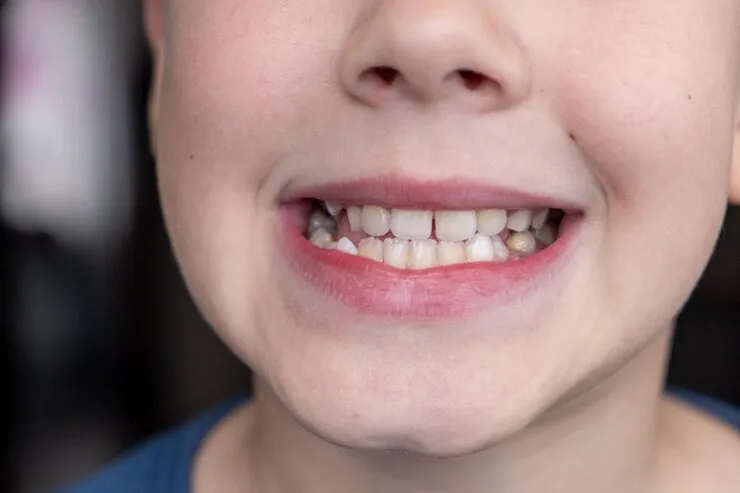
Significant overjet
Upper front teeth protrude far beyond the lower, altering tongue and lip reference points for fricatives.

Missing upper front teeth
Removes the surface needed for certain fricatives and sibilants, often leading to temporary changes that improve after prosthetic replacement.

Narrow or high-arched palate
Limits space for the tongue to rest and elevate, associated with mouth breathing, thumb sucking, and enlarged tonsils/adenoids.

Posterior crossbite
A lateral jaw shift associated with unilateral crossbite can affect tongue posture and resonance.
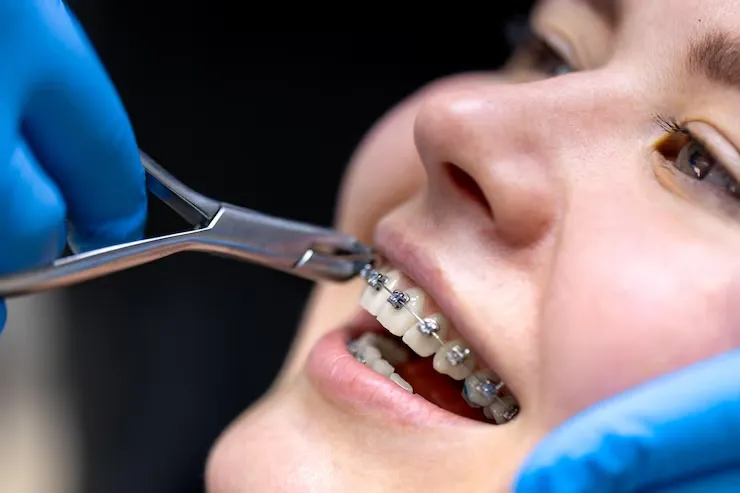
Orthodontic appliances
Braces and expanders temporarily alter tongue space and contact points; most patients adapt within weeks, though some notice ongoing changes during treatment.
How We Assess Speech-Related Oral Concerns
At Dental Solutions Clinic in Bangalore, a focused structural assessment includes: Clinical frenum examination and grading.
- Tongue mobility testing (elevation, protrusion, lateralisation, tip control).
- Dental and bite assessment (alignment, open bite, crossbite, arch form).
- CBCT imaging is used when arch width, palatal anatomy, or impacted teeth need 3D evaluation.
- Close coordination with your SLT or referral to one when combined structural and functional care is required.

How We Treat Bite Problems

Laser Frenectomy for Tongue Tie and Lip Tie
Tongue and lip ties at Dental Solutions Clinic are released using the Fotona LightWalker Er:YAG laser. This technology allows precise, minimally traumatic cutting with good haemostasis and typically minimal swelling or discomfort, often reducing the need for sutures and shortening recovery time compared with conventional methods. Procedures usually take 15–30 minutes and are performed under topical or local anaesthesia, depending on age. Post-release stretching and functional exercises are provided to reduce the risk of reattachment and improve tongue function.

Orthodontic Treatment for Open Bite, Misalignment, Narrow Arch
When speech issues are linked to misaligned teeth, open bite, or narrow arches, orthodontic treatment with Invisalign clear aligners or fixed appliances — planned by Dr. Ramya — addresses the structural cause. Many patients notice changes in articulation as tooth positions improve, even before treatment is completed.

Palatal Expansion
In children and teenagers with narrow palates, a palatal expander gradually widens the upper arch, improving tongue space, jaw development, and often breathing and speech clarity. Expansion is most effective while facial growth is still active.

Prosthetic Tooth Replacement
Where missing front teeth impact speech, replacing them with a dental implant and crown, bridge, or temporary partial restores the physical structures that guide normal articulation. Implants provide a stable, bone-preserving long-term solution; removable or transitional options may be used while definitive treatment is in progress.
Frequently Asked Questions
At what age should tongue tie be treated?
Tongue tie can be treated at any age when it clearly affects feeding, speech, or oral development. In infants with breastfeeding difficulties linked to tongue restriction, early release can quickly improve latch and maternal comfort. In toddlers and children with speech or swallowing issues, combining release with myofunctional and speech therapy helps prevent long-term compensatory patterns. Adults also benefit from release when functional symptoms are present, although retraining established patterns may take longer.
Will frenectomy alone fix my child’s speech?
Not usually. Frenectomy removes a physical restriction but does not automatically change how the tongue moves in speech. For older children and adults with long-standing compensations, post-release myofunctional and speech therapy are often needed to achieve full benefit. In infants, where the primary issue is feeding, and the release occurs early, formal speech therapy may not be necessary.
What is the difference between a tongue tie and a lip tie?
Tongue tie (ankyloglossia) involves a restricted lingual frenum under the tongue, limiting its movement. A lip tie involves a restrictive attachment of the upper labial frenum to the gum, limiting lip mobility. Both can affect feeding in infants and, in some cases, articulation or oral hygiene later on. Both can be treated with a laser frenectomy when clearly symptomatic.
My child has a lisp. Is it always related to tooth position?
No. A lateral lisp is often functional and not primarily related to tooth position, responding well to speech therapy. A frontal or interdental lisp is more frequently associated with open bite, spacing between teeth, or tongue thrust patterns. A combined evaluation by a dentist and SLT gives the clearest picture of whether structural treatment, therapy, or both are needed.
Can adult tooth misalignment cause speech problems?
Yes, especially when tooth position changes later in life — after tooth loss, denture placement, or restorative work that alters the bite. Many adults with long-standing malocclusion have adapted speech, but new articulation changes following dental changes should be assessed. Reviewing and, if needed, adjusting the bite or restorations is often the first step.