Laser dentistry | Fotona LightWalker treatment in Indiranagar, Bangalore
Laser dentistry is not a single procedure but a set of techniques that use focused light energy to perform many common dental treatments with greater precision and comfort. Results depend on the exact laser used, the wavelength, the settings, and most importantly, the training and experience of the clinician operating it.
At Dental Solutions Clinic in Indiranagar, Bangalore, laser treatment is performed using the Fotona LightWalker, a dual-wavelength system (Er:YAG and Nd:YAG) designed for both hard-tissue and soft-tissue procedures. Laser‑based gum, bone, root canal, and soft‑tissue treatments are carried out by Dr. Balasubramanya K V — MDS Periodontics, LANAP Certified Practitioner, Fotona LightWalker Certified Operator, with a Diploma and Master’s in Laser Dentistry from the University of Vienna, and by Prosthodontist Dr. Ramya Balasubramanya for selected restorative and root canal procedures.

What is laser dentistry?
A dental laser produces a concentrated beam of light at a precise wavelength. Depending on how that wavelength interacts with water, blood, enamel, dentine, or bone, it can cut, reshape, or disinfect tissue.
Different wavelengths suit different tasks. Some work best on gums and soft tissue; others on teeth and bone; and some are ideal for deep cleaning and disinfection.
The Fotona LightWalker operates at two proven dental wavelengths:
Nd:YAG (1064 nm) Absorbed well by blood and pigmented tissue. Used for advanced gum treatments like LANAP, deep pocket disinfection, bleeding control, and low-level laser therapy (to stimulate healing).
Er:YAG (2940 nm) Strongly absorbed by water and the minerals in teeth and bone. Used for precise cutting of hard and soft tissue, laser-assisted root canal disinfection, cavity preparation, gum reshaping, and soft-tissue surgery — with minimal heat spread.
Most dental lasers offer only one wavelength. The LightWalker’s dual-wavelength design enables DSC to offer a broader range of evidence-based laser procedures from a single system.
The key differentiator is integration: using a scanner but still pouring stone models, or owning CBCT but taking physical implant impressions, does not capture the full accuracy and efficiency that digital systems can offer. The real clinical benefit comes when every stage is connected.
Digital Technologies at Dental Solutions Clinic

Nd:YAG‑based protocol for moderate to advanced gum disease that selectively targets infected tissue and bacteria while helping the gums re‑attach, usually with no cutting or stitches.

Full‑mouth gum treatment combining Er:YAG deep cleaning under the gums with Nd:YAG bacterial reduction and healing support, used alongside scaling and root planing.

Er:YAG photoacoustic irrigation (such as PIPS) helps flush bacteria and debris from tiny side canals that conventional needle irrigation cannot easily reach, improving disinfection in complex root canals.

Er:YAG reshaping of gums (and, when indicated, a small amount of bone) to expose more tooth for crowns or to correct a “gummy smile”, with minimal bleeding and often few or no stitches.

As part of Digital Smile Design cases, an Er:YAG laser is used to gently sculpt the gum line around the front teeth for a more even, symmetrical smile before veneers, crowns, or bonding are placed, providing more precise and predictable cosmetic results.

In selected whitening cases, laser energy can be used to activate or accelerate in-office bleaching gels on the tooth surface, helping achieve noticeable shade improvement with shorter chair time while standard sensitivity control and isolation protocols are followed.

Frenectomy (tongue tie and lip tie release)
Er:YAG release of tight tongue or lip attachments with minimal bleeding and faster, more comfortable healing compared with scalpel techniques, suitable for infants, children, and adults.

Targeted Er:YAG/Nd:YAG treatment on exposed root surfaces or recently prepared teeth to reduce sensitivity by sealing tiny tubules and calming nerve response.

Laser decontamination in gum pockets is used with standard scaling or during periodontal surgery to reduce bacterial load and help clean difficult‑to‑reach root and bone surfaces.

Low‑power Nd:YAG settings are used after surgery or in TMJ‑related cases to reduce pain and swelling and support faster healing (photobiomodulation).

For early decay screening, a DIAGNOdent laser pen is used along with a visual exam and X‑rays to measure fluorescence changes in enamel and dentine, helping detect small hidden cavities, especially in pits and fissures where decay can be hard to see, allowing earlier, more conservative treatment.

White patches and thickened areas on the inside of the mouth can sometimes be pre-cancerous or cause discomfort. The Er:YAG laser precisely removes or reduces these patches, often in combination with a biopsy to check the tissue, resulting in less bleeding and faster healing than a scalpel.

The Er:YAG laser removes benign soft tissue growths inside or around the mouth — such as fibromas, warts, cysts, and small lumps on the gums. Precise, near-bloodless, and usually requires no stitches.
Why the Fotona LightWalker system matters
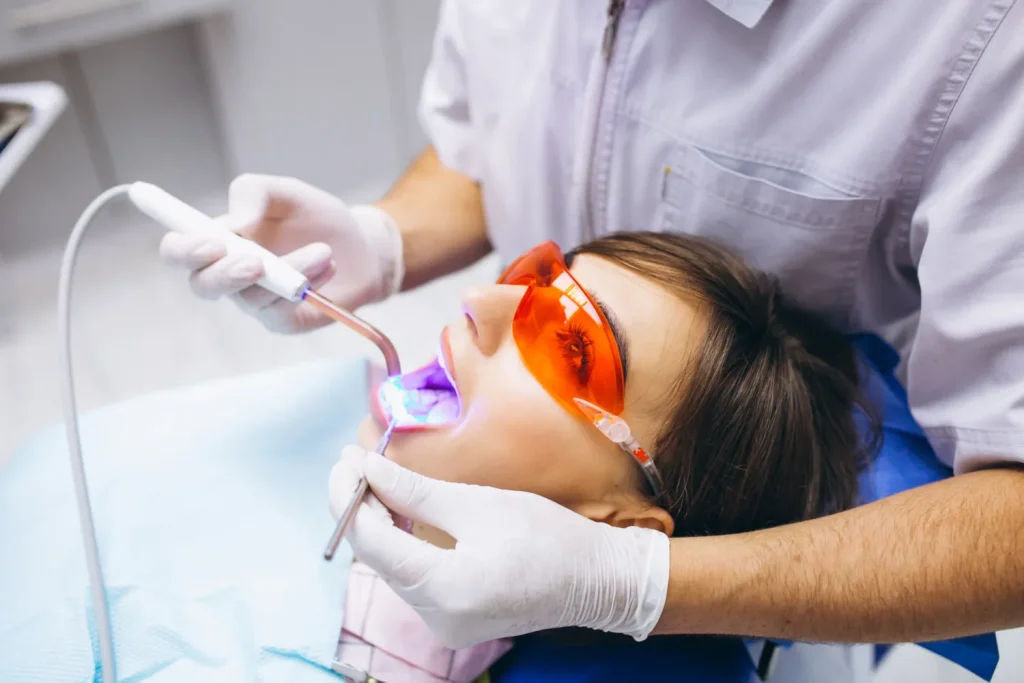
Not all dental lasers can safely or effectively handle the same procedures. The LightWalker is specifically designed as a dual-wavelength hard and soft tissue platform with preset, research-based protocols for a wide range of applications.
Clinical studies show that Nd:YAG-based LANAP, when properly performed, can achieve greater pocket depth reduction and better bacterial control than scaling alone. Er:YAG, meanwhile, cuts enamel, dentine, and soft tissue efficiently with minimal thermal damage to surrounding tissue.
At DSC, laser treatment is delivered only by clinicians with formal, university-level training in laser dentistry and manufacturer certification for the LightWalker system. This ensures that power settings, pulse modes, and techniques follow published protocols and safety standards.
Clinical advantages of laser dentistry at DSC

Less bleeding and fewer stitches
Many soft‑tissue laser procedures seal small blood vessels as they work, leading to cleaner, drier surgical fields and, in many cases, little or no need for suturing.

High precision and tissue preservation
Focused laser energy allows very selective removal of diseased or excess tissue while preserving as much healthy tooth, gum, and bone as possible.

Reduced post operative discomfort and swelling
The way Er:YAG and Nd:YAG interact with tissue, combined with low‑level laser healing protocols, often results in milder post-treatment pain and faster recovery than equivalent scalpel or electrosurgery procedures.

Enhanced disinfection
In periodontal pockets and root canals, laser energy can reach and disrupt bacteria in areas that are difficult to clean mechanically, supporting better long-term outcomes.
Frequently Asked Questions
Is laser dentistry painful?
Most patients find laser procedures more comfortable than scalpel or electrosurgery. Local anaesthetic is still used where needed, but the laser itself usually causes little to no pain during treatment and tends to produce less soreness afterwards because it seals small blood vessels and nerve endings as it works.
Is laser dentistry safe?
Yes, when used by a well‑trained clinician with the correct settings and proper safety measures, such as protective eyewear. The key is operator training and protocols; at DSC, all laser procedures are performed by a dentist with postgraduate qualifications in laser dentistry and who follows strict safety guidelines.
How is laser treatment different from conventional treatment?
For gums and soft tissue, lasers usually mean less bleeding, fewer or no stitches, better visibility, and often milder post‑treatment discomfort. In gum disease, LANAP can selectively target diseased tissue and bacteria while preserving healthier supporting tissue. In root canals, laser-activated irrigation can clean and disinfect areas that conventional tools struggle to reach.
Can every dental procedure be done with a laser?
No. Lasers are excellent for certain tasks like gum surgery, periodontal therapy, root canal disinfection, some cavity preparations, and healing support, but they do not replace drills, implants, or braces. At DSC, lasers are used only where they clearly add value over standard methods, not as a blanket substitute.
How do I know if laser treatment is right for me?
You do not need to decide this yourself; your dentist will recommend laser options when they offer a clear benefit for your specific condition, such as advanced gum disease, complex root canals, gum reshaping, or frenectomy. During your consultation, the team will explain why a laser approach is (or is not) advised in your case and what results you can expect.