
Gum Disease — From Gingivitis to Periodontitis: Diagnosis & Treatment in Bangalore
Gum disease is a spectrum of conditions, beginning with mild, reversible inflammation and potentially advancing to severe stages. If untreated, it can lead to significant destruction of teeth and bone, which cannot be replaced.
The key point is that most people with gum disease do not experience pain. The condition remains silent until it becomes severe. When teeth start feeling loose, significant bone loss has already occurred. Similarly, persistent gum bleeding indicates ongoing inflammation for months or years. Detecting the problem early makes a crucial difference.
At Dental Solutions Clinic in Indiranagar, Bangalore, the team evaluates gum disease, categorises it according to the latest international standards, and provides treatment tailored to its severity. Dr. Balasubramanya K V, a specialist Periodontist with BDS, MDS (Periodontics), and a diploma in Laser Dentistry from the University of Vienna (SOLA), leads the department. He is certified in LANAP and Fotona LightWalker procedures and has over 25 years of expert experience in periodontal treatment.

Gum Disease — The Three Primary Forms

Stage 0–1: Gingivitis
Gingivitis is the earliest stage. Gums are inflamed, with no bone loss. It is completely reversible through professional treatment. Signs include red, swollen, or bleeding gums; most cases are painless.

Stage 2–4: Periodontitis
Advanced gum disease (periodontitis) involves loss of bone and tissue. It is treatable but cannot be reversed, making early intervention essential. Indicators include deep pockets, bleeding, bad breath, and loosened teeth.

Mucogingival: Gum Recession
Exposure of the root surface due to receding gum tissue can lead to sensitivity, aesthetic concerns, and a higher risk of tooth decay. Indicators include visible roots, increased tooth sensitivity, and longer-looking teeth.
How Gum Disease Develops
Most patients assume gum disease is simply a hygiene problem. It is more specific than that. Here is what is actually happening in the tissue:
- 1. Plaque accumulates along the gum line and in the gum crevice (the sulcus).
- 2. Bacterial toxins within that plaque trigger an immune-inflammatory response in the surrounding gum tissue.
- 3. Blood vessels in the inflamed tissue dilate and engorge. The epithelial lining of the sulcus thins and ulcerates.
- 4. Any mechanical contact — brushing, eating, probing — causes these fragile vessels to rupture. This is the bleeding you notice.
- 5. If the inflammation is not resolved, bacterial infection spreads below the gum margin. The sulcus deepens into a periodontal pocket.
- 6. Bacteria reach the supporting structures: the periodontal ligament is destroyed, and bacteria begin to resorb the alveolar bone beneath.
- 7. As bone is lost, pockets deepen, teeth lose their structural foundation, and eventually become mobile or fall out.
Common Causes of Gum Disease
Plaque is the trigger, but susceptibility varies significantly between patients. The following causes and risk factors determine how quickly gum disease develops, how severe it becomes, and how well it responds to treatment.

Plaque Build-Up and Poor Oral Hygiene
When plaque is not removed consistently through brushing and interdental cleaning, it mineralises into calculus (tartar) within 24–72 hours. Calculus cannot be removed at home. It provides a permanent scaffold for further bacterial colonisation along and beneath the gum line. This is the primary cause of gum disease in the vast majority of patients, and it is entirely preventable.

Gingivitis That Has Not Been Treated
Gingivitis — inflammation of the gum tissue without affecting the bone — is a reversible early stage that can lead to periodontitis. Many patients are simply told their gums are ‘a bit inflamed’ and are given a leaflet on flossing. However, without professional treatment and follow-up to ensure it resolves, gingivitis often progresses to periodontitis. This progression is painless and usually goes unnoticed.

Smoking and Tobacco Use
Smoking stands as a major modifiable risk factor for periodontitis. Nicotine induces vasoconstriction, which diminishes bleeding and hides the earliest warning signs, while also impairing immune defence, decreasing oxygen delivery to gums, and delaying healing. Smokers tend to experience more severe disease progression, respond poorly to treatments, and are more prone to relapse. Therefore, the lack of bleeding in a smoker does not indicate healthy gums.

Uncontrolled Diabetes
The connection between diabetes and gum disease goes both ways. Poor blood sugar control hampers neutrophil activity, increases inflammatory cytokines, and delays healing, all of which worsen periodontal health. On the other hand, severe gum disease makes it more difficult to manage blood sugar. Several clinical studies have shown that successful periodontal treatment can lower HbA1c levels in people with diabetes. When treating a patient with diabetes and gum disease, this relationship is carefully considered.

Hormonal Changes: Pregnancy, Puberty and Menopause
Elevated progesterone during pregnancy increases the gingival inflammatory response even to small plaque amounts, leading to pregnancy gingivitis that can be quite noticeable even in patients with good oral hygiene. Puberty and menopause induce similar, though milder, increases in gingival sensitivity. Hormonal fluctuations alone do not cause gum disease, but considerably reduce the amount of plaque needed to trigger an inflammatory response.

Medications
Several common medications affect gum health and are frequently overlooked as contributing factors. A detailed medication review is part of every initial assessment at Dental Solutions Clinic.
When to Seek Assessment
Do not wait for pain. Seek a periodontal assessment if you notice any of the following:
- Gums that bleed when you brush, floss, or eat
- Red, swollen, or tender gum tissue
- Persistent bad breath that brushing does not resolve
- Gums that appear to be pulling away from your teeth
- Teeth that feel loose or have shifted position
- Sensitivity at the gum margin or on the root surface
If you are diabetic, pregnant, or have a family history of gum disease, a periodontal assessment should be part of your routine dental care even without these symptoms.

How We Assess and Diagnose Gum Disease
Gum disease isn’t visible during routine check-ups and requires clinical measurements for accurate staging. Creating a treatment plan without a proper diagnosis is essentially guesswork. Our assessment protocol is developed to provide both you and us with a clear, precise understanding of what is occurring and why.

Full Periodontal Charting
Six-point probing of every tooth, recording: pocket depth, clinical attachment level (CAL), bleeding on probing (BOP), suppuration, furcation involvement, and tooth mobility. The result is a complete periodontal map of your mouth — the document that drives every subsequent treatment decision.

Digital Periapical Radiographs (RVG)
Full-mouth periapical X-rays to assess bone levels around every tooth. Bone loss visible on a standard radiograph represents at least 30% mineral loss — meaning early changes require clinical correlation to detect. We do not rely on a single panoramic image where precision periapical assessment is needed.

Panoramic OPG
Full-arch overview radiograph used as part of the initial assessment and whole-mouth treatment planning, particularly when multiple quadrants are involved, or implant planning is being considered alongside periodontal management.
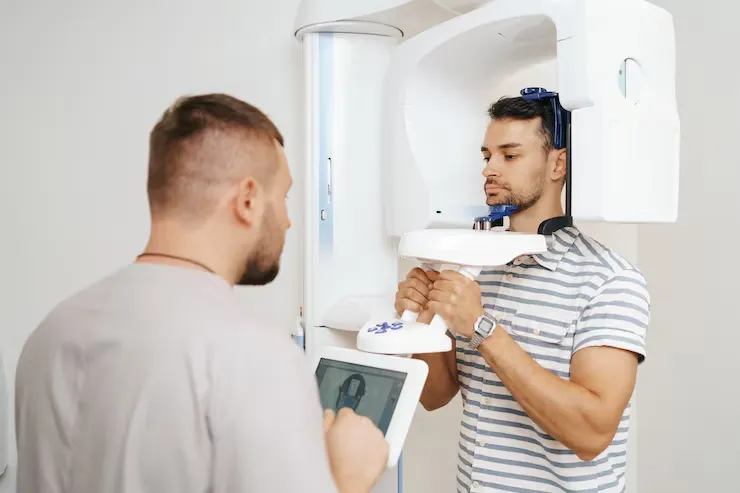
3D CBCT Scanning (Where Indicated)
Three-dimensional bone mapping using the PLANMECA ProMax 3D scanner. Used for Stage 3–4 disease, complex vertical bone defects, furcation lesions, and pre-implant periodontal assessment. CBCT reveals bone architecture that is invisible on conventional two-dimensional radiographs.

Systemic and Medical Assessment
Structured medical history review, including diabetes screening where indicated, full medication reconciliation, and smoking status evaluation. Systemic factors are not noted and then ignored — they are incorporated into the staging, grading, and treatment plan.

Staging and Grading (2017 World Workshop Classification)
Disease is classified using the current international standard — the 2017 World Workshop on the Classification of Periodontal and Peri-Implant Diseases. Stage reflects disease severity and complexity. Grade reflects rate of progression, risk factors, and systemic impact. Together, they determine whether your disease is managed non-surgically, with laser therapy, or with surgical intervention.
Treatment Options for Gum Disease
Treatment is staged to match disease severity. We do not apply the same protocol to early gingivitis and advanced periodontitis. The options below, from least invasive to most invasive, are selected based on your staging outcome.

Professional Debridement for Gingivitis
Gingivitis is fully reversible. Supragingival and subgingival plaque and calculus are removed using ultrasonic scalers and hand curettes. When gum pockets are shallow and bone is intact, thorough professional debridement combined with improved home care resolves gingivitis completely in most patients within 4–6 weeks. A reassessment at 4 weeks confirms resolution and identifies any areas requiring further attention.

Scaling and Root Planing (SRP) for Early Periodontitis
For Stage 1–2 periodontitis, full-mouth subgingival debridement — scaling and root planing — is the first-line treatment. Root surfaces are thoroughly debrided of plaque, calculus, and bacterial endotoxins under local anaesthesia. SRP alone, when performed thoroughly and followed by consistent home care, produces clinically significant reductions in pocket depth and halts disease progression in most Stage 1–2 cases.

LANAP — Laser-Assisted New Attachment Procedure
Where pockets of greater than 5mm persist following initial debridement, LANAP — performed with the Fotona LightWalker Nd:YAG laser — is recommended. LANAP selectively destroys periodontal pathogens and diseased pocket epithelium without damaging healthy tissue. Clinical studies demonstrate new cementum formation, regeneration of the periodontal ligament, and measurable bone fill in treated sites. It is performed under local anaesthesia, with significantly less post-operative discomfort than flap surgery and no sutures required in most cases.

WPT — Wavelength-Specific Periodontal Therapy
WPT uses the dual-wavelength Fotona LightWalker system (Nd:YAG + Er:YAG) to decontaminate periodontal pockets, remove diseased tissue, and biostimulate healing in a single protocol. It is used for Stage 2–3 disease as an alternative or adjunct to LANAP, and is particularly effective where full-mouth laser debridement is required across multiple quadrants.

Surgical Periodontal Therapy for Advanced Disease
Stage 3–4 periodontitis with deep vertical bone defects, furcation involvement, or disease that does not respond adequately to non-surgical treatment may require open flap debridement — providing direct access to root surfaces and bone defects that cannot be reached from above the gum line. This is combined, where indicated, with guided bone regeneration (GBR) using resorbable membranes and bone graft materials to reconstruct lost support.
All surgical cases are planned from CBCT imaging and discussed in detail before treatment begins. Where teeth are assessed as having a hopeless prognosis, strategic extraction, implant planning, and periodontal rehabilitation are coordinated as part of the same treatment plan.

Systemic Co-Management
Where gum disease is linked to diabetes, medication effects, pregnancy, or haematological conditions, we co-manage with your physician. Written periodontal reports are provided for your medical team, and treatment protocols are adjusted to account for systemic factors. In diabetic patients, we monitor HbA1c trends alongside clinical periodontal response.
Frequently Asked Questions
Do I need to see a dentist if my gums bleed?
Yes — address it promptly, not eventually. Bleeding gums are the earliest and most common sign of gingivitis or periodontitis. They won’t resolve on their own without professional plaque and calculus removal, which causes the inflammation. Waiting to see if the bleeding stops is a common reason patients end up with preventable bone loss. Even if the bleeding appears minor, it should be evaluated within two to four weeks.
Can gum disease cause tooth loss?
Periodontitis is the main cause of tooth loss in adults. It damages the bone anchoring the teeth, and as more bone is lost, teeth may become loose, fall out, or need extraction. The progression usually occurs slowly and painlessly and can be entirely prevented if detected early, during gingivitis or the initial periodontitis.
Is gum disease reversible?
The approach depends on the stage. Gingivitis is entirely reversible, as professional cleaning and good home care can restore gum health. In contrast, periodontitis cannot be fully reversed because lost bone cannot be completely regenerated, but it can be effectively treated and managed. With proper treatment and ongoing maintenance, patients can retain their teeth for many years. Early intervention makes the treatment simpler and more successful.
How does gum disease differ from simply having sensitive or bleeding gums?
Sensitivity and bleeding are symptoms rather than diagnoses. They may result from gingivitis, early or advanced periodontitis, traumatic brushing, medication effects, or systemic conditions. This distinction is important because each condition requires different treatment. The only way to determine the exact cause is through a thorough periodontal assessment, including clinical probing, attachment level measurement, and radiographic bone evaluation. A visual check or regular hygiene visit alone cannot provide this information.
How long does gum disease treatment take?
The treatment varies depending on the disease stage. Gingivitis usually clears after one or two professional cleanings, with a follow-up check at four weeks. For stage 1–2 periodontitis, treatment typically includes two to four sessions of scaling and root planing, with a review after six to eight weeks. Using LANAP or WPT for Stage 2–3 disease involves two to four laser sessions, with tissue response monitored over eight to twelve weeks. More complex surgical cases are planned on an individual basis. After active treatment, patients always enter a structured maintenance programme.
My general dentist said my gums are fine. Should I still get a periodontal assessment?
If your dentist completed and reviewed a full six-point periodontal chart and assessed radiographic bone levels, then the necessary steps have been taken. However, if only a visual assessment was done, or if you show any of the warning signs listed here, consulting a periodontal specialist is advisable. Gum disease is often underdiagnosed in general practice, not due to negligence, but because a comprehensive periodontal evaluation requires time and specialised training to interpret correctly.