
Dental Caries Diagnosis in Bangalore | Early Cavity Detection at DSC, Indiranagar
The cheapest cavity to treat is the one you catch early. Enamel-only decay can often be reversed without drilling; dentine decay needs a filling, and decay reaching the nerve usually needs root canal treatment. The timing of detection determines which one you need.
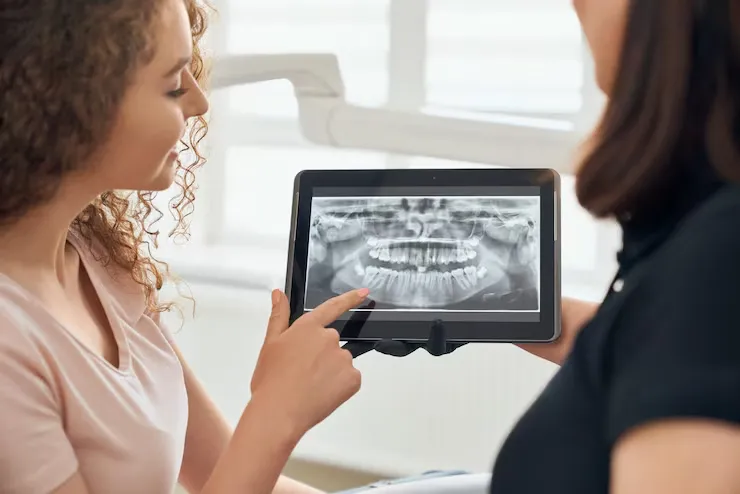
Routine visual checks and X‑rays find most cavities but can miss early or hidden decay in deep grooves, between teeth, or just under the surface. DIAGNOdent closes this gap by detecting decay before it becomes visible or painful, when it is still easiest to treat.
At Dental Solutions Clinic, Indiranagar, Bangalore, DIAGNOdent laser caries detection is built into every new patient exam and recall visit for anyone with caries risk, used by Dr. Ramya Balasubramanya and Dr. Balasubramanya K V as part of a fully digital diagnosis workflow.
What Is DIAGNOdent?
DIAGNOdent (KaVo) is a laser fluorescence device that scans the tooth with a low‑power 655 nm beam. Healthy enamel reflects the light one way, while bacteria and their by‑products in early and established caries fluoresce more intensely, and the device converts this signal into a 0–99 reading.
Results are instant and measurable: scores under 14 at a fissure usually mean sound or minimally affected enamel, 14–20 suggest early enamel lesions, and above 20 usually indicates dentine involvement needing treatment. This data reduces guesswork, so borderline areas can be recorded, reviewed at recall, and treated only if they worsen.
Why early detection matters
DIAGNOdent usually finds problems at the enamel or early dentine stage, when care is simplest and least invasive.
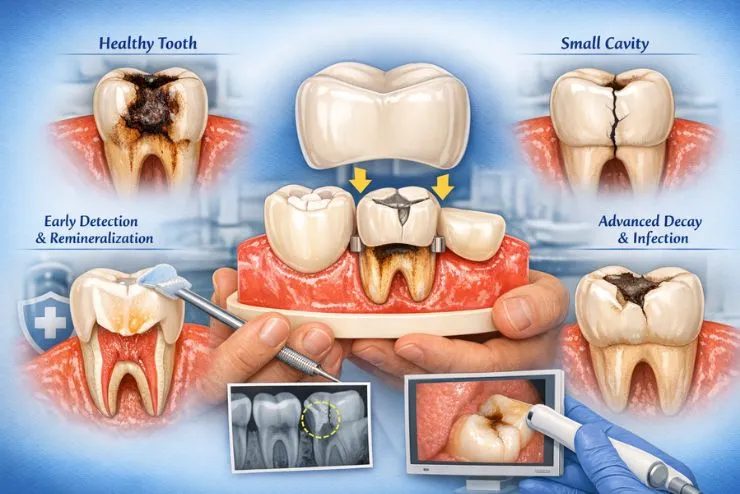
- Enamel stage: decay is confined to enamel and can often be reversed with fluoride and diet changes, without drilling.
- Dentine stage: decay has entered dentine, so a filling is required, and the cavity is larger.
- Pulp stage: decay reaches the nerve, needing root canal treatment and a crown, with greater cost and complexity.
- Abscess: infection reaches the bone, and extraction may be needed, risking tooth loss.
When DIAGNOdent is used at DSC
- At every comprehensive new‑patient exam, a baseline map of fissures and smooth surfaces is recorded.
- At recall visits for patients with past decay, high sugar intake, low saliva, or orthodontic
- Before placing fissure sealants, ensure that the grooves are caries-free.
- To track early lesions (for example, a site that moves from 12 to 18 is now treated).
- For brace‑wearers with white spots around brackets, to grade severity and plan remineralisation.
- For high‑risk patients (xerostomia, reflux, uncontrolled diabetes) to prevent rapid progression.
DIAGNOdent vs traditional caries detection
| Aspect | VISUAL + EXPLORER / X-ray | DIAGNOdent |
|---|---|---|
| Detection stage | After a cavity forms (Stage 2+) | Before cavitation (Stage 1) |
| Fissure lesions | May miss subsurface decay | Detects the earliest fissure changes |
| Between-tooth surfaces | Depends on bitewing X-rays | Supports X-rays on smooth surfaces |
| Quantification | Yes/no clinical judgement | Objective 0–99 number |
| Monitoring over time | Subjective comparison | Documented readings for review |
| Radiation | None/low (visual/X-ray) | None (laser light only) |
What happens when early decay is found?

Reading below 14 – sound or minimal risk:
No cavity; tooth is healthy or only superficially stained. No treatment, just a baseline record.
Reading 14–20 – early enamel lesion:
Demineralisation without a cavity. Ideal time for intervention with high‑fluoride varnish, CPP‑ACP products, diet advice, and improved home care. The site is rescanned at recall; falling readings show healing, rising readings lead to a small composite filling.
Reading above 20 – active decay:
A cavity is present or very likely to be present, so treatment is advised. Small dentine lesions are managed with a conservative composite filling, often prepared with an Er:YAG laser, and larger areas may require a composite inlay or onlay. Further delay is not recommended.
Frequently Asked Questions
Does DIAGNOdent replace X rays?
No. DIAGNOdent is best for early decay on biting and smooth surfaces, while bitewing X‑rays are still essential for detecting cavities between teeth, so both are used together at DSC.
Is the DIAGNOdent laser safe?
Yes. It uses a very low‑power 655 nm red diode laser with no ionising radiation and does not heat, cut, or change the tooth, making it suitable for children, pregnant patients, and those with implants or ceramic work.
My tooth doesn’t hurt. Why do I need screening?
Tooth decay is usually painless until it nears or reaches the pulp, at which point root canal treatment is often required; DIAGNOdent helps find decay much earlier, while it is still a small enamel lesion.
If a lesion is found, do I need a filling immediately?
Not always. Early enamel changes are usually managed with remineralisation, diet changes, and better hygiene, and only when readings show dentine involvement or progression despite prevention is drilling recommended, because DSC aims to treat as little tooth as possible, as late as is safely possible.